
One Bill Away From Empty While the Stock Market Hits Record Highs
Guardian Rock Wealth September 2026 Market Commentary
By John Browning, MBA and CSA® | CEO, Principal

Is the number the government reports for inflation the same number showing up in your bank account every month? For most families, it is not even close.
Sarah fills her cart the same way she has for years, but somehow the total at checkout keeps climbing faster than her paycheck. She now fills her tank twice a month instead of once; she cannot fill it all the way; she needs to leave enough in her account to cover her rising electric bill when it comes due.
She has done everything right. She has a savings account. She does not carry credit card debt. And yet, by the end of every month, she feels like she is falling further behind. Sarah is not imagining it. Her personal inflation rate, the one that shows up in real life, is running well above the number in the headlines.
This is life for hundreds of thousands of families across the U.S. right now. Most people reading this may have a hard time identifying with that reality. Many of us notice the price increase, but for most of us it just means a few less luxuries, maybe putting off that trip, or waiting a few more months to buy that new car.

The number that does not match your receipts
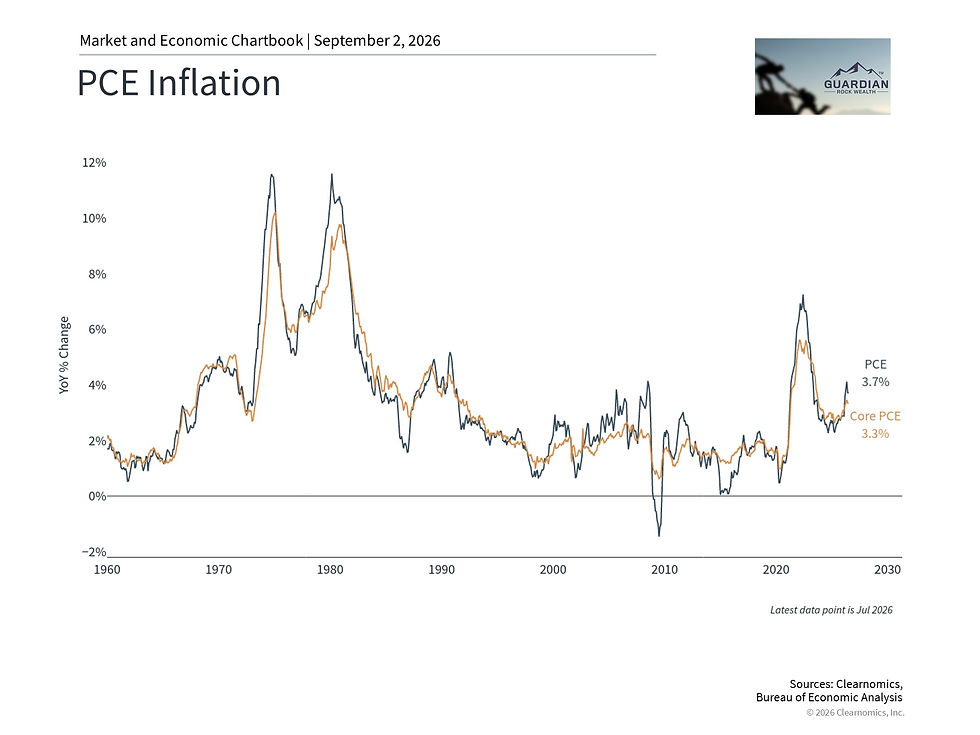
The Personal Consumption Expenditures index, or PCE, showed prices up 3.7 percent year over year in July, with core inflation at 3.3 percent. Both numbers are calculated from a broad basket of goods and services meant to represent the average American household.
Here is the problem. You are not the average American household.
Nobody is.
The government's basket assumes a certain mix of spending on housing, medical care, entertainment, gasoline, and groceries. Your household has its own mix, and that mix determines your personal inflation rate. If gasoline and groceries make up a bigger share of your monthly budget than they do in the government's basket, your real cost of living is rising faster than the headline number, sometimes much faster.
And this year, gasoline is Exhibit A. U.S. gasoline prices have climbed more than 40 percent since late February, according to AAA and U.S. Energy Information Administration data. That household expense has grown more than ten times faster than headline inflation, and it does not stop at the pump. Diesel moves the trucks that stock the grocery shelves. Higher fuel costs move into food prices, freight costs, and eventually almost everything that must be grown, built, or delivered.
So when someone asks whether inflation is under control, the honest answer is that it depends on whose life you are measuring it against. For a family that drives to work, buys groceries every week, and pays for gas, heat, or a gas stove, the real number can feel closer to double the official one.
Where did everyone put their money?
Faced with a market at all-time highs and an economy that feels uncertain, many people have done the seemingly sensible thing. They have parked their money in cash.
Money market fund assets recently hit a record high of approximately $7.9 trillion, according to the Investment Company Institute. That is more money sitting in cash equivalents than the entire gross domestic product of every country on earth except the United States and China.
Cash feels safe. Cash does not go down in a single trading session. Cash lets you sleep at night. All of that is true, and cash reserves play a real role in a financial plan.
But here is the twist of the knife. That cash is earning a yield that is running well behind a 40 percent jump in gasoline prices and real increases in grocery, insurance, and housing costs. Money sitting in a “safe” account is not frozen in place. It is silently losing purchasing power every single month, more invisibly than a stock market decline. A stock market drop makes headlines. A silent loss of purchasing power does not, which is exactly why it is more dangerous.
Nobody panics about something they cannot see happening.
Risk assets are not the easy answer either
If cash is silently losing ground, the obvious next question is whether investors should simply move that $7.9 trillion into stocks, bonds, or other risk assets instead. It is not that simple, and anyone who tells you that deserves a healthy dose of skepticism.
The stock market has had a strong year, but strong does not mean smooth. The S&P 500 fell nearly 19 percent between mid-February and early April, driven by a wave of new tariff announcements. Anyone who panicked and sold anywhere near that low point locked in a real loss.
Then, in one of the sharpest reversals in years, the index turned around and gained nearly 20 percent between early April and mid-May. Anyone who needed to pull money out right at the bottom, for a required withdrawal, a distribution, or simply out of fear, missed almost the entire recovery. The market didn't care about anyone's personal timeline. It moved when it moved, and whether that timing helped you or hurt you had nothing to do with skill. Unless you had a wealth management system in place.
That is the part most investors never plan for. It is not just about whether the market goes up over time. It is about whether you are forced to sell at the exact moment it is down. A pilot flying through a cloud bank cannot trust what their eyes and inner ear are telling them, because both can be dead wrong with zero visibility outside the window. Pilots are trained to trust their instruments instead: the altimeter, the attitude indicator, the airspeed indicator, because those instruments keep working even when human senses fail. A wealth management system is built to work the same way. It gives you something to trust and follow when the headlines and your own gut are telling you to do the opposite.

By August, the S&P 500, Nasdaq, and Dow Jones Industrial Average had climbed 12.3 percent, 13.5 percent, and 10.7 percent year to date, up 2.6 percent, 3.9 percent, and 1.3 percent in August alone.
The S&P 500 has repeatedly reached new all-time highs, supported by earnings that are genuinely strong across most sectors, not just a handful of large technology companies.
But strong does not mean risk-free going forward. The S&P 500 currently trades at roughly 20 times earnings, compared to a historical average closer to 16 times. Analysts are now forecasting 15 percent earnings growth in each of the next two years, more than double the long-run historical average of 7 percent. That is a lot of good news already baked into today's prices, which means there is less room for anything to go wrong.

Meanwhile, interest rates have climbed to levels many younger investors have simply never seen. The 30-year Treasury yield touched its highest level since 2007 in August, closing near 5.24 percent, and the 10-year yield has pushed toward 4.80 percent. Higher rates raise the bar every investment must clear to be worth owning, and they compete directly with stocks for investor dollars.
So here is the real conundrum facing investors today:
Cash feels safe but is silently losing purchasing power. Stocks and bonds offer the chance to outpace inflation but can fall nearly 20 percent in seven weeks and recover nearly 20 percent in the next five, with no warning and no regard for when you personally need the money.
There are no easy answers and no perfect hiding place. The answer is not to choose cash or to choose the market. The answer is a wealth management system with clear rules and built-in cash flow, one you actually follow, so that even when it feels like it is not working, it actually is.
Growing national debt and borrowing add another layer of complexity
This backdrop gets more complicated when you add in what is happening in Washington. The national debt now exceeds $40 trillion for the first time in history, and the Congressional Budget Office projects the annual budget deficit to reach $2.1 trillion for the current fiscal year. Tariff refunds, resulting from a Supreme Court ruling that last year's “Liberation Day” tariffs were illegal, have added to the near-term deficit, with $129 billion in refund claims already accepted for processing.

When a government owes this much money, it only has three ways out.
1. It can raise taxes enough to pay the debt down, or it can let inflation shrink the real value of what it owes over time. Raising taxes is politically painful and slow, and there is no sign it will happen anytime soon since politicians want to get re-elected
2. Cut spending, which gets talked about a lot but never actually seems to get done.
3. Inflating the debt away is the option almost every government in history has chosen instead, because it doesn't require a vote in Congress, and most people never even notice until their savings don't stretch as far as they used to, and then most don’t understand why.
That choice does not just affect government bonds. It hits hardest for anyone holding cash, because the whole reason cash feels safe is the assumption that a dollar today will still be worth close to a dollar tomorrow. When a government is actively working to shrink the value of its own currency over time, that assumption breaks down.
None of this means the sky is falling. The federal government has run a deficit in all but five years since 1970, and well-run wealth management systems and even most well-balanced portfolios have still grown over that same period.
But that does not mean you should assume holding more cash is automatically the conservative choice. In an environment where inflation is the government's most likely path forward, cash may be the riskiest safe-looking asset in the portfolio.
What Guardian Rock Wealth is watching over the next 12 to 18 months:
Between now and the midterm elections in November, and continuing into next year, we are watching several threads that all connect back to the same question: whether households have a real plan for protecting and growing purchasing power.
· Whether the Federal Reserve raises rates once, twice, or holds steady, and what that means for both cash yields and stock valuations.
· Whether gasoline and food costs keep climbing faster than headline inflation, and what that is doing to the real personal inflation rate of everyday families and, in turn, what that means for the consumer.
· Whether money market balances start moving back into productive investments, or whether the $7.9 trillion cash pile keeps growing out of fear rather than strategy.
· Whether corporate earnings growth can deliver on the aggressive 15 percent forecasts already priced into today's valuations.
· Whether the growing national debt and rising long-term interest rates begin to change the math on retirement income, borrowing, and real estate.
The lesson from decades of watching markets move through good years and bad is this. Productivity, technology, and long-run economic growth are what ultimately drive results, not any single headline about inflation, tariffs, or the Fed. Staying focused on a long-term plan, rather than reacting to any one month's number, is still what gives investors the best odds of reaching their goals.
The question worth thinking through...
If your cash is silently losing purchasing power every month, and the stock and bond markets both carry real risk at today's prices, where exactly are you planning to hide? What is the consequence of doing nothing?
Most people don't have good answers to those questions because most people don't have a real system.
They have a checking account, a savings account, and a portfolio built once and mostly left alone, in the hope they will “be O.K.” That is not a wealth management system.
A real wealth management system does not ask you to guess whether the Fed hikes or cuts, whether gas prices keep rising, or whether the stock market is about to correct. It is built around a disciplined, rules-based approach that automatically adjusts how much is in cash, how much is at risk, and how much is protected, based on mathematics rather than emotion or headlines. That kind of system is not something you build once and forget. It is something you build, monitor, and adjust, month after month, year after year.
If you want a calmer, more deliberate way to think about your wealth system, not just your portfolio, Guardian Rock Wealth can help.
My question to you is this: if your cash is silently losing purchasing power every month, and the market can fall nearly 20 percent without warning, does your plan tell you exactly what to do next, or does it leave you guessing right when guessing is the most dangerous thing you could do?
Nothing in this update should be considered personal investment guidance. This content is for educational purposes only. Please consult with your own financial, tax, and legal professionals before making decisions for your specific situation.


Comments