
Your House Made You Rich. Now It Won’t Let You Leave.
Guardian Rock Wealth October 2026 Market Commentary
By John Browning, MBA and CSA® | CEO, Principal

The Hidden Cost of 7% Mortgages, Expensive Money, and a Financial Plan Built for Yesterday.
What if the biggest cost of higher interest rates is not a lower bond price, but a life decision you can no longer afford to make?
A couple bought their home when mortgage rates were near 3%. The home rose in value, their careers changed, and the house no longer fit their life. Then they ran the numbers on moving and discovered that a similar home at a 7% mortgage rate could raise the monthly payment by thousands of dollars. On paper, they were wealthier. In real life, they felt trapped.

Expensive money is changing more than markets
The Federal Reserve raised its target rate by one quarter of a percentage point in September, bringing the federal funds range to 3.75% to 4.00%. This was the first increase in three years. It was also widely expected, which helps explain why markets absorbed it without a major break.
But the reason for the increase deserves more attention than the increase itself.
The Fed is responding to inflation being pushed higher largely by energy and supply pressures. That is different from an economy where consumers are simply spending too much. The Fed can make borrowing more expensive. It cannot reopen a shipping lane, produce a barrel of oil, or settle a war.
That creates an uncomfortable possibility for the next 12 to 18 months: interest rates may stay high enough to slow housing, refinancing, and business activity without quickly fixing the source of inflation.
This is not a prediction of disaster. It is a reason to ask a better question.
What parts of your financial life were built on cheap money, and what happens if cheap money doesn't return soon?

The Fed raised its target range to 3.75% to 4.00% in September after a cutting cycle that ran from September 2024 through December 2025. The chart shows that policy has changed direction, not that it proves assets must fall.
The Fed is reacting, not controlling
Investors often talk about the Federal Reserve as if it were steering the economy with perfect information. It is not. Monetary policy works with delays, and the Fed is often reacting to conditions it did not create and cannot directly control.
Higher rates are not automatically bearish for stocks. Rates and stock prices can rise together when economic growth and corporate profits remain strong. Over the past six months, major stock indexes have moved toward record levels even as long-term yields climbed to levels not seen in roughly two decades.
The right question is not, “Did the Fed raise rates?”
The better questions are:
Why did the Fed raise rates?
What is already reflected in prices?
Which households and businesses are most exposed?
Which parts of a portfolio are exposed to higher rates?
Where is liquidity moving while the market waits?

Rate increases have occurred across very different economic environments. The path of earnings, inflation, employment, and liquidity matters more than the label “rate hike” by itself.
Housing is where expensive money becomes personal
The average 30-year fixed mortgage rate reached well over 7.00%, up from 6.95% a week earlier. That shift affects mobility, affordability, and the flow of money through the economy.
Millions of homeowners refinanced or bought homes when mortgage rates were near 3%. Selling now means giving up a low fixed payment and replacing it with a much larger one. Economists call this the lock-in effect.
30-Year Fixed Mortgage | Monthly Principal & Interest | Monthly Difference |
$500,000 at 3% | $2,108 | — |
$500,000 at 7% | $3,327 | +$1,219 |
Illustrative principal-and-interest payments only; exclude property taxes, homeowners’ insurance, mortgage insurance, and closing costs.
The result is a slowing housing market. Existing home sales fell 2.0% in August from the prior month and 1.2% from a year earlier. Existing home inventory reached 4.9 months of supply, the highest level in more than a decade. New-home supply reached 8.5 months. Yet national home prices remain near record levels.
Activity is weak, but prices have not collapsed . . . yet.
That can happen when many owners have low mortgage rates, stable employment, and no urgent reason to sell. It can also hide growing friction beneath the surface. Families may delay moving for a job, downsizing in retirement, buying a larger home, or relocating closer to family because the financing math no longer works.
Housing touches far more than real estate. Fewer transactions can mean less spending on furniture, appliances, flooring, renovations, moving services, title work, and local contractors. Mortgage rates are just the tip of the proverbial iceberg.

Mortgage rates returned above 7% after spending much of the post-2008 period far below that level. The issue is not only affordability for new buyers. It is the low-rate lock-in effect for existing owners.
The missing refinancing channel
Higher rates have also reduced mortgage refinancing to multi-year lows. During the pandemic period, refinancing let many homeowners lower payments or turn part of their home equity into spendable cash. At today's rates, that channel is largely closed.
That does not mean household balance sheets are in 2008-style distress. Household debt service was about 11% of disposable income in the second quarter, compared with nearly 16% before the financial crisis.
The risk is slower and less dramatic. A family can have substantial home equity and still have less usable cash flow. A business owner can be wealthy on paper and still be reluctant to borrow. A retiree can own a valuable home and still struggle to turn it into flexible income without taking on an expensive loan.
That is why net worth and financial freedom are not the same thing.
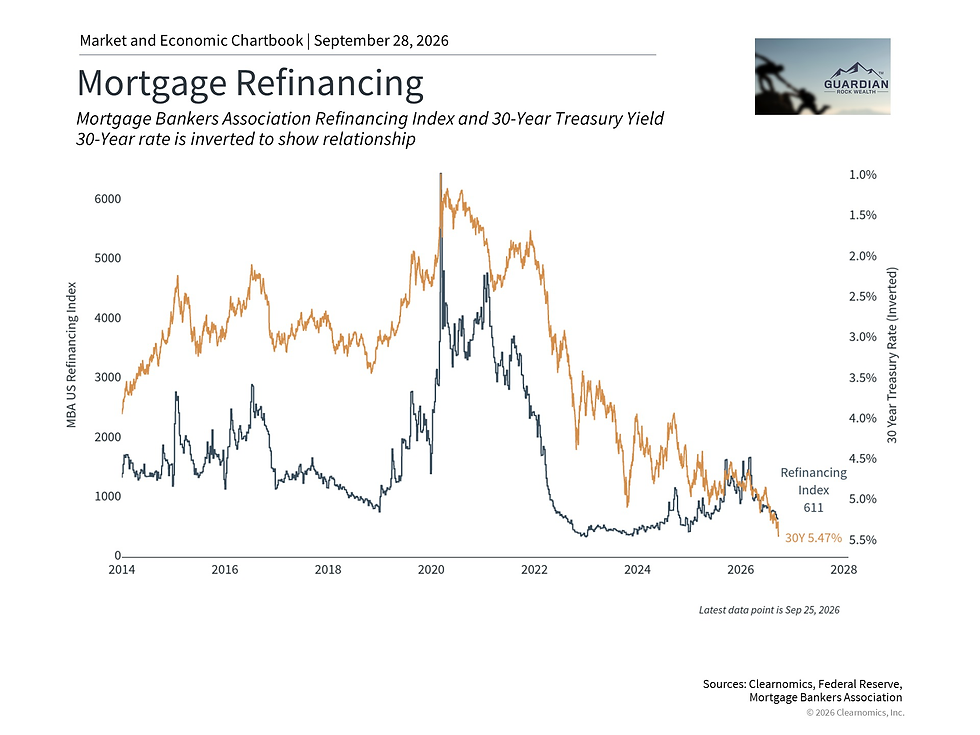
Refinancing activity has fallen sharply as long-term rates rose. Less refinancing can reduce the flow of home equity into consumer spending.
Inflation is changing the job of cash and bonds
The August Consumer Price Index showed energy prices up 16.3% over the prior year and gasoline up 27.4%. At the same time, long-term Treasury yields rose sharply, and bond prices fell. On September 24, the 10-year Treasury yield was 5.18%, and the 30-year yield was 5.47%.
Those higher yields create both opportunity and risk.
New bonds can offer more income. Existing long-duration bonds can lose value quickly when yields rise. Cash can feel safe because the account balance does not move much, but inflation reduces what cash buys, so its purchasing power can erode quickly.
This is why every dollar needs a job.
Liquidity dollars can protect near-term spending and prevent forced selling, but these dollars should still earn the inflation rate, or close to it, after taxes.
Income dollars should support reliable cash flow without reaching blindly for yield. This is not likely to be found in traditional fixed-income securities.
Growth dollars should have enough time to weather volatility and deliver the desired results.
Legacy dollars should be coordinated with tax and estate decisions.
A pile of cash is not a plan. A bond label does not reduce risk. An investment portfolio is not automatically a wealth-management system.
A strong market can still be fragile
Recent market gains have again depended heavily on a small group of very large companies. That concentration does not mean the market must fall. It means investors should understand how much of their result depends on the same earnings expectations, artificial-intelligence capital spending, and valuation assumptions.
Often a few fast-rising holdings can quietly and quickly change a portfolio's risk. A strong company can still become an oversized position. A strong story can still be priced for perfection. Portfolio drift is not a strategy or a system.
The goal is not to abandon growth. The goal is to avoid requiring one narrow group of investments to carry out the entire plan.
Debt, gold, and what governments do instead of what they say (follow the money flow)
U.S. federal debt is above 122% of gross domestic product on the broad total-debt measure. Meanwhile, central banks added a net 289 metric tons of gold to reserves in the second quarter, according to the World Gold Council. This continues a four-year trend of elevated purchases, alongside renewed interest in repatriation.
That does not prove the dollar is about to fail. It does show that large institutions and governments are diversifying reserve risk while the U.S. and others continue to borrow heavily. Add to this the fact that the spread between investment-grade debt and non-investment-grade debt is spiking higher, and credit default swaps are also rising in price, and the warning lights seem to be flashing for anyone depending too heavily on stock or bond prices staying steady and certainly for anyone depending on the value of their cash to save the day.
When governments increase hard-asset reserves while long-term yields rise, the useful question is whether a family's liquidity, income, and long-term purchasing power all depend on one interest-rate outcome or one market story.
Staying invested still matters, and structure matters more
One of the clearest charts below shows the growth of one dollar since 1926. Inflation increased the cost of living roughly nineteen-fold over that period. Stocks and bonds still outpaced inflation over the long run.
The lesson is not to remain fully invested in anything at any price. Long-term wealth typically comes from owning productive assets, staying disciplined, and giving the plan enough time to work.

Inflation steadily reduced purchasing power, while diversified ownership of productive assets supported long-term growth. Historical returns do not guarantee future results.
What Guardian Rock Wealth is watching
Over the next month:
Whether the 10-year and 30-year Treasury yields remain near recent highs.
When energy inflation starts showing up more obviously in other categories.
Whether mortgage rates stay above 7%, housing transactions weaken further, and that weakness eventually appears in home prices.
Whether consumer spending continues to reflect weaker refinancing activity and higher fuel costs.
Over the next 12 to 18 months:
Whether the Fed can contain inflation without causing a sharp slowdown.
Whether high rates expose weak balance sheets, excessive duration, or refinancing risk.
Whether housing lock-in becomes a longer-term drag on mobility and consumer activity.
Whether heavy Treasury issuance keeps pressure on long-term yields.
Whether central-bank gold buying and other reserve shifts continue.
Better Questions = Better Results
A portfolio answers, “What do I own?”
A wealth-management system answers better questions:
What is each dollar supposed to do?
Where will retirement income come from?
What happens if rates stay high?
What happens if inflation stays above target?
What can be sold without creating a tax problem?
Where is liquidity when the market or life changes quickly?
Who coordinates investments, taxes, income, estate planning, and family decisions?
If your current plan works only if mortgage rates fall, the Fed cuts, the dollar stays strong, and a small group of stocks continues to lead, do you have a wealth system or a collection of assumptions?
If you want a calmer, more deliberate way to think about your wealth system, not just your portfolio, Guardian Rock Wealth can help.
My question to you is this: if your cash is silently losing purchasing power every month, and the market can fall nearly 20 percent without warning, does your plan tell you exactly what to do next, or does it leave you guessing right when guessing is the most dangerous thing you could do?
Nothing in this update should be considered personal investment guidance. This content is for educational purposes only. Please consult with your own financial, tax, and legal professionals before making decisions for your specific situation.


Comments